Showing posts with label Women of History. Show all posts

Tuesday, 17 April 2018

Sarah (Flower) Adams 1805 to 1848


Sarah (Flower) Adams was born February 22, 1805 in Old Harlow,Essex to the second daughter Benjamin Flower and Eliza Gould.

Her father held radical views on the politics and religious beliefs of his day, and published his beliefs in the Cambridge Intelligencer landing himself a six-month jail sentence in 1793.  His literary and radical ideals meant that Sarah grew up in a home visited by radical thinkers and famous literary people most notably Robert Browning and Harriet Martineau.  Surrounded as she was by literature, poetry and independent thought it is no surprise that she aspired to write works of poetry and politically based literature.  

Sarah’s mother had died when she was 5 years old thus when her father died in 1829 Sara and her sister became wards of William Johnson Fox.  Fox was an outspoken journalist and Unitarian, like Sarah’s father, Fox’s home was visited often by radical and progressive thinking people.  Fox encourage Sarah to write hymns for his congregation the South Place Unitarian Chapel, London.

At the age of 27 Sarah started to write for the Monthly Repository and in 1834 married William Bridges Adams.  William shared Sarah passion for literature and innovative thought thus is was with his blessing she entered into a period of acting where she experienced success and it became too physical strenuous for her having inherited her mother’s fragile constitution and  she retired from the stage.

No longer able to express herself on stage once again she turned to writing poetry, lyrics for hymns and followed through with writing a dramatic poem  Vivia Perpetua, A Dramatic Poem (1841) following in the footsteps Robert Browning whom she knew well.   In her writing she expressed her views on the church, and needs for equality for the working class and women.  While Vivia Perpetua failed to meet the standards of Robert Browning is does reflect Sarah's personality and her beliefs as no other piece of her writing.

During the same period she wrote what she has become famous for the hymns “Nearer, my God! To Thee” and “He sendeth sun, he sendeth shower” which was sung at Sarah's graveside.

Sarah died on August 14, 1848 from tuberculosis and was described by Richard (Garrnett, n.d.) “a woman of singular beauty and attractiveness, delicate and truly feminine, high-minded, and in her days of health playful and high-spirited.”

Sarah Flower Adams is a woman of history and it is right that we remember her today and the power found in writing to change and influence history.

Grandma Snyder
©twosnydergirls
 References
Garrnett, R. (n.d.). Critical and Biographical Essay by Richard Garnett Sarah Flower Adams (1805-1848). Retrieved from https://www.bartleby.com/293/72.html

Graves, D. (2010, April 28). Sarah Flowers Adams. Retrieved from Christianity.com: https://www.christianity.com/church/church-history/timeline/1801-1900/sarah-flower-adams-11630348.html

Miles, A. H. (n.d.). Critical and Biographical Essay by Alfred H. Miles Sarah Flower Adams (1805-1848). Retrieved from  :  http://www.bartleby.com/294/124.html


Sarah Fuller Flower Adams. (n.d.). Retrieved from Wikipedia: https://en.wikipedia.org/wiki/Sarah_Fuller_Flower_Adams

Thursday, 25 January 2018

Writing is as necessary as breathing for some


Writing for some of us is as necessary as breathing. 

Writing as a form of self discovery, spending time everyday writing down thoughts uninhibited by checking spelling, grammar, sentence structure or who will read it in the future.

Virginia Woolf was the pioneer of this type of writing - stream of consciousness writing. 

She wrote this way to discover her characters, writing to understand them better.

Today writing through stream of consciousness is also called brain dumping and it is described as a great way to begin your day and other say it is a great way to end the day and clear your mind for sleep.

What I know is that writing is necessary and I have been keeping a journal for the past 50 years, and through my writing I have come to know myself to be the person I am.


Grandma Snyder


©2013-2018 twosnydergirls  

January 25, 2018

Thursday, 5 January 2017

Kathleen Kenyon

Dame of the British Empire 
January 5, 1906 to August 24, 1978


Kathleen was born in England where she grew up the oldest child in a home of where biblical authority and history held equal sway.  Her family home was physically attached British Museum, where her father was the director.

She is referred to as being strong headed, stubborn, and a tomboy.  She won awards for Somerville College Oxford where she was studying archaeology for her skills as a hockey player.  She also became the first female president of the Oxford University Archaeological Society ad graduated from Somerville College in 1929.  

Her first job on archaeology sites was as a photographer, she learned her skills in stratigraphic excavation, the process of  swiping the surface of a site and moving back through history during the summers of 1930-1935 where she worked alongside  Mortimer Wheeler in Zimbabwe.


While actively working dig sites from 1948 to 1962 Kathleen also lectured on archaeology all over the world inspiring men and women in this field.

It was Kathleen's work on the Jericho wall that earned her the title as one of the most influential archaeologist of the 20th century.  

Kathleen meticulous sifted through inch after inch of soil and artifacts painstaking 
moving from modern times all the way to a stone age foundation.  Kathleen came to two conclusion the first was that Jericho is the oldest continuously inhabited community and the second was that the wall of Jericho fell long before the Bible places Joshua at the site.

In 1973 five years before her death Queen Elizabeth II named Kathleen Dame of the British Empire for her work.

Kathleen died from a stroke at age 72, and she was one of the influential archaeologist of the 20th century.

Kathleen Kenyon is a woman of history.

Grandma Snyder
©2013-2017 twosnydergirls

Read more about Kathleen in this articles:
  1. Kathleen Kenyon  Wikipedia 
  2. Kathleen Kenyon and Jericho Bible Odyssey
  3. Kathleen Kenyon: Larger Than Life   Vision

Thursday, 14 January 2016

Susan Le Flesche Picotte


Susan LaFlesche Picotte was born on June 17, 1865 on the Omaha Indian Reservation in Nebraska, the youngest of four girls.  Her mother Mary Gale was half French and half Omaha and her father Joseph LaFlesche was half white and Omaha.

Joseph LaFlesche played an important role in the Omaha nation and believed that if they were to survive they would need to become like the white people who were overtaking their lands.  Thus Joseph ensured that Susan received a white education and this meant being sent off reserve to attend school.

Early in Susan life she is described as witnessing the death of an Omaha person because the white doctor would not provide treatment.  Her outrage at this is described as placing her on a path that would see her become a physician at a time in history when women were believed to be unfit mentally to handle the rigors of higher education and add to this that she was aboriginal as well. 

Once obtaining her medical training she returned to the Omaha nation where she worked tirelessly as the residential boarding school physician and quickly thereafter to the people of Omaha.  In this position she earned substantially less than white doctors, and when medical supplies ran out it was from her personal earnings that she paid for needed supplies.


She married and had two sons, while continuing her medical practice.  She was active in the temperance movement knowing first hand the affects of alcohol on aboriginal families, her husband was an alcoholic. 

She was a public health activist, educating the Omaha people on how to prevent the spread of disease, in particular the prevention and treatment of tuberculosis and Susan was instrumental in building of a hospital on the Omaha reservation.

She was also a political activist, writing letters to government on behalf of herself and others on the issue of land entitlement.


There is a wonderful YouTube video called Drums of Change - a Nebraska Story about Susan LaFlesche Picotte click here if you would like to be directed to the 4 minute video produced by NetNebraska  


Susan LaFlesche Picotte is a Woman of History and her story is a powerful example to women today


Please visit these sites to learn more about Susan LaFlesche Picotte the first Native American Physician 
Grandma Snyder

©2013-2016 twosnydergirls


Wednesday, 14 January 2015

Emily Hahn


Emily Hahn was called “a forgotten American literary treasure” by The New Yorker magazine.  In her life time she wrote 52 books and over a hundred articles.  She was born in St. Louis Missouri on January 14, 1905 and died February 18, 1997.  She came from a working class family, where she and her five brother and sisters were encourage to think for themselves, to push social boundaries and so it was that in a time where working class women were not expected to have professional careers, Emily set about doing just the opposite.


Emily was the first women to graduate with a degree in Mining Engineering.  It is said that she changed her major from English to Engineering when she was discouraged from taking a chemistry course because women did not understand math and complex chemical equations, and this set the course for the rest of her life – Emily Hahn was an early feminist and adventurer.  She lived life to the fullest with pride in herself and her accomplishments.

In 1930 inspired by Charles Lindbergh, Emily Hahn set out once again to push the boundaries as she embarked on an exploration of  the African continent,  She worked in a hospital and lived with a local tribe during this adventure and it is said that she walked across Africa in her quest for freedom and adventure.


Emily also lived in China during the Communist revolution and much of her writing is focused on this period of her life.  She is frequently credited with introducing the western world to China and Asian culture.   

 ''My younger daughter once rebuked me for not being the kind of mother one reads about,'' Ms. Hahn once told an interviewer. ''I asked her what kind that was, and she said, the kind who sits home and bakes cakes. I told her to go and find anybody who sits at home and bakes cakes.''  Emily Hahn Source of this quote

Ken Cuthbertson has written of Emily Hahn’s life in “Nobody Said Not to Go: The Life, Loves and Adventures of Emily Hahn” a book well worth finding at your local library and reading.

Emily Hahn's granddaughter had this to say about her grandmother

"Chances are, your grandmother didn't smoke cigars and let you hold wild role-playing parties in her apartment.  Chances are that she didn't teach you Swahili obscenities. Chances are that when she took you to the zoo, she didn't start whooping passionately at the top her lungs as you passed the gibbon cage. Sadly for you ... your grandmother was not Emily Hahn." Alfia Vecchio Wallace
 To read more about Emily Hahn please click on the links below


 Grandma Snyder

©2013-2016 twosnydergirls

Tuesday, 9 September 2014

Jane Addams a Woman of History


Jane was born September 6, 1860 the youngest of nine children.  Her childhood was marked by death and disease.  Her mother died when she was two years old, four of her siblings by her eighth birthday and at four Jane was diagnosed with Pott’s disease, tuberculosis which left her spine disfigured, she grew up believing herself to be ugly.
Influenced by the writing of Charles Dickens, Tolstoy, Mazzini’s Duties of Man, the stories of her mother’s work with poor of Cedarville and fathers political views, Jane grew-up with a strong belief that society did not have to stay the same that social change was possible if people care and Jane Addam did care.

She graduated from Rockford Female Seminary, in Rockford Illinois only to have tragedy visited Jane once again, her father died.  Her inheritance allowed Jane to realize her dream.

Jane traveled to in England where she experienced firsthand the benefits of the Settlement movement and upon her return to the United States she started the Settlement Hull house in Chicago.


Jane moved into the Hull house and lived there until her death on May 21, 1935.  Within this enlightened, socially conscious community Jane found the opportunity to put her ideas for social change and social advocacy to paper, writing eleven books and many articles.

A pacifist Jane wrote and advocated loudly for peace and the human treatment of all people during and after WWI chairing the Women’s Conference for Peace in the Hague and founded the Women’s International League for Peace and Freedom.

In 1931 Jane was the second woman and the first American woman to receive the Noble Peace Prize.  Jane worked for social reform for immigrants, women and children assisting in the development of:
  • Immigrants Protective League
  • Juvenile Protective Association
  • the separation of adult and juvenile courts
  • Legislation for women and children
  • is considered a founding agent in the field of Social Work
  • and so much more


Jane Addams is a woman who while living a financially privileged life she used her intelligence and inheritance to make social change happen.  

As parents and grandparents let’s tell Jane Addams’ story to our children and encourage them to explore literature that challenges our current social norms and encourage independent thought and boldness in the face of social injustice.  

Finally is not enough to acknowledge the problems in our society.  Jane was also influenced by her parents behaviors - their action.  

We the parents and grandparents of today have within us the power to do something about the social injustice we see – we need to volunteer, walk, bake, stalk shelves to become active in changing the social injustice that we see around us.


Please learn more about Jane Addams explore the links below:


Grandma Snyder

©2013-2014 twosnydergirls

Monday, 26 May 2014

Florence Nightingale


The-Lady-with-the-Lamp

May 12, 1820 to August 13, 1910

I met Florence Nightingale when I was ten years old, she was the heroine in a book I was given for my birthday.  I was so taken by her story that she became the basis for that year’s public speaking topic and as a young adult a role model for me as I trained to become a nurse.
This is the book that I read and click here to link to Amazon

Florence Nightingale was born May 12th, 1820, and 194 years later her example continues to influence and motivate young women and men.
Florence was born into a family of privilege with a tradition of taking on issues of social justice, her maternal grandfather was the abolitionist William Smith.  

As a woman she was expected to marry well and Florence believing that God had a different purpose for her life she repeatedly propositioned her parents to allow her to become a nurse.  In 1851 they gave their permission and Florence spent three months training in Germany before becoming a hospital nurse in England.

The unsanitary conditions under which wounded British soldier’s in the Crimean War were having to endure resulted in the British minister of war seeking Florence’s helping.  Thus the “Lady-with-the-Lamp” was born as Florence Nightingale supervised a team of 38 nurses in Turkey.   

A lady with a lamp I see
Pass through the glimmering gloom,
And flit from room to room

On England’s annals through the long
Hereafter of her speech and song
That lights its rays shall cast
From portals of the past

A Lady with a Lamp shall stand
In the great history of the land,
A noble type of good
Heroic womanhood.
~ Longfellow

Upon her return to England Florence established the Nightingale Training School at St Thomas' Hospital in London where she trained nurses and influenced the operations of hospitals in the human and sanitary care of the sick and injured.  
 In 2014 we can still see Florence Nightingales influence in the training of nurses and the guiding principles that under pin the operation of our hospitals.

In the mid 1950's Florence Nightingales story set a young girl on her path to become a nurse and later a social worker.  Let’s continue to tell Florence Nightingales story and motivate future generations of care givers both young women and young men.

If you would like to read more about Florence Nightingale please visit these websites:


Grandma Snyder

©2013-2014 twosnydergirls

Thursday, 8 May 2014

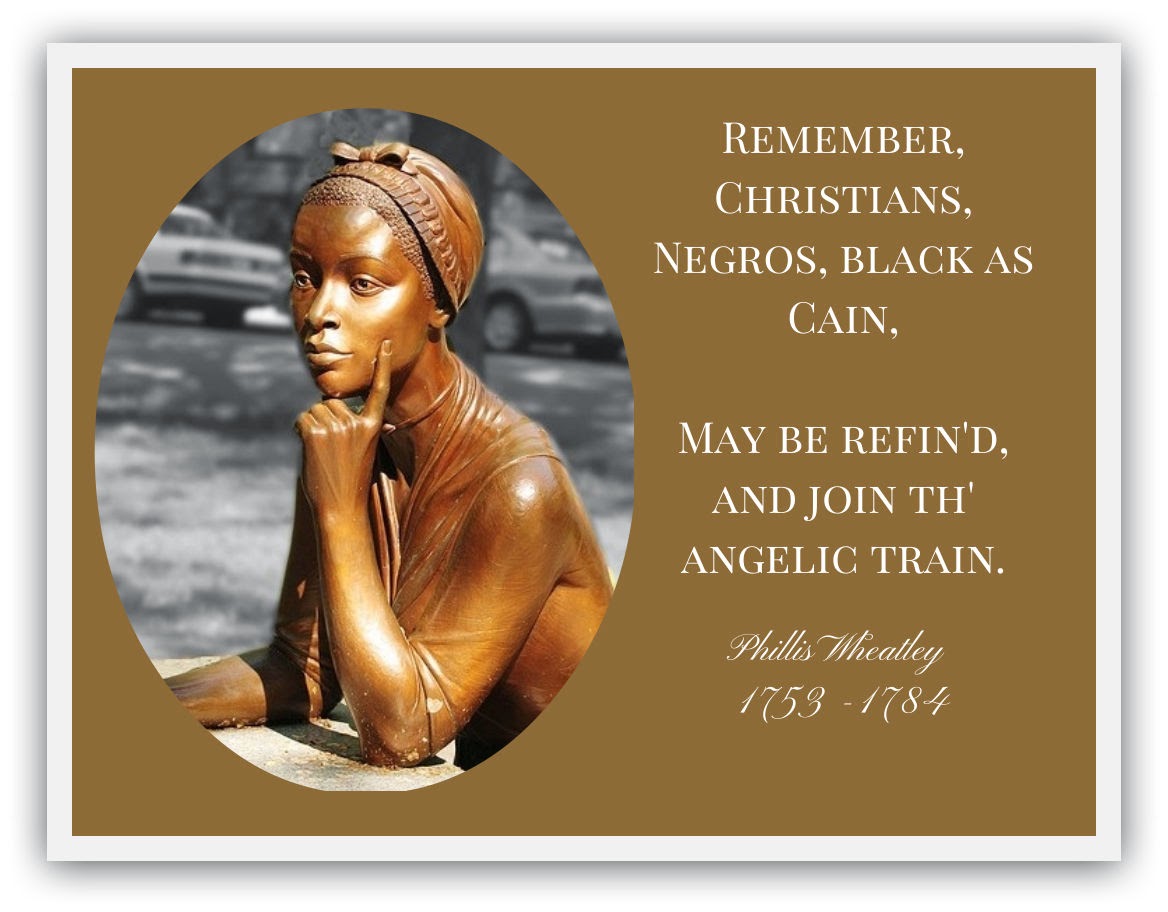
Phillis Wheatley a Woman of History


May 8, 1753 to December 5, 1784
Phillis Wheatley
Phillis was born in Senegambia West Africa a free African child and at the age of seven sold into slavery and transported to North America where she was sold to the Wheatley family as the personal servant to Mrs. Wheatley.

As a house slave and Mrs. Wheatley’s personal servant Phillis had what was considered a privileged life and Mrs. Wheatley taught Phillis to read and write after recognizing an intelligence and creative ability believed impossible in Blacks.

By 1771 Phillis had distinguished herself as a poet and an oddity given her status as an African slave having written up to 28 poems.  As a result she was allowed to travel with the Wheatley’s son to London England where she was invited to meet members of the British Upper Class, many of whom were notable abolitionists.

While in England the Countess of Huntingdon provided the funding to publish a volume of Phillis’ poems, “Poems on Various Subjects, Religious and Moral” was published in 1773.  

As was the tradition Phillis was the first African American Woman to be published.  Phillis was published under the name Wheatley as slave were known by the last name of their owners.

John Wheatley left instructions that Phillis as his property be emancipated upon his death.  Phillis’ freedom rather than being the beginning of a better life thrust her into a life of poverty and physical hardship, no longer living within the Wheatley household she was forced to make her own way.  

In April 1778 she married John Peters and they are reported to have had up to three children who all died in infancy.  In 1784 Peter’s was imprisoned for none payment of debt and the same year Phillis died.

Click here to link to Phillis' Poems


Phillis’ intelligence and notoriety as a published poet acted as an early catalyst for the antislavery movement.  New discoveries of her early “poems, [and] letters associate her with the eighteenth-century black abolitionists” http://www.poetryfoundation.org/bio/phillis-wheatley
 
Phillis is a woman of history.  She was supported to develop her skills, encourage to step outside of the known boundaries of her class by her white owner and she took risks writing poetry that addressed the equality of black slaves to an all white audience. 


On Being Brought from Africa to America
By Phillis Wheatley

'Twas mercy brought me from my Pagan land,
Taught my benighted soul to understand
That there's a God, that there's a Saviour too:
Once I redemption neither sought nor knew.
Some view our sable race with scornful eye,
"Their colour is a diabolic die."
Remember, Christians, Negros, black as Cain


To read more about Phillis Wheatley please follow these links


Grandma Snyder
©2013-2015 twosnydergirls